
Table of Contents
- Start With How the Room Is Used
- Make a Quick Room-and-Routine Plan
- Choose the Main Seating Shape
- Get Scale and Measurements Right
- Match Comfort to the Household
- Select Upholstery for Real-World Conditions
- Use Custom Details to Solve Room Problems
- Plan Around Conversation and Movement
- Balance Style With Long-Term Flexibility
- Quick Decision Checklist
- Common Questions
- Choose for Life Inside the Room
A beautiful sofa can still be the wrong choice if it blocks a walkway, feels awkward during movie night, or does not offer enough support for everyday use. The best living room seating starts with real routines: who uses the room, how long they sit, whether they host guests, work from home, read, watch television, relax with pets, or need space for children to play.
For homes with unusual dimensions or specific comfort requirements, tailored furniture can be worth considering early in the planning process. Rawhide Furniture Inc., a Toronto-based maker of handcrafted leather and fabric furnishings, offers custom upholstered sofas Toronto homeowners can personalize by size, seating style, arm design, back cushions, materials, and leg finishes. Its custom upholstery options are especially useful for Toronto-area households trying to make seating work in narrow rooms, open-concept spaces, or layouts that need a more precise fit.
Start With How the Room Is Used
Before comparing styles, picture an ordinary week in the room. A formal conversation space has different needs than a family room used for streaming, snacks, naps, and weekend visitors. Good seating supports comfort, movement, and the activities that happen most often, rather than simply filling an empty wall.
1. Make a Quick Room-and-Routine Plan
Measure the room’s length and width, then note ceiling height, windows, doors, vents, radiators, outlets, fireplaces, built-ins, and the routes people use to move through the space. Identify the room’s primary purpose: conversation, television, reading, entertaining, remote work, or a combination of these.
It also helps to list who uses the room. A couple who mainly read may need two supportive chairs and a small table. A large family may benefit more from generous shared seating and an ottoman that can double as a footrest or extra perch.
2. Choose the Main Seating Shape
- Standard sofa: A flexible choice for smaller rooms, apartments, guest seating, or layouts that may change later.
- Sectional: Useful in larger family rooms where people regularly lounge together, and there is enough floor space to maintain clear paths.
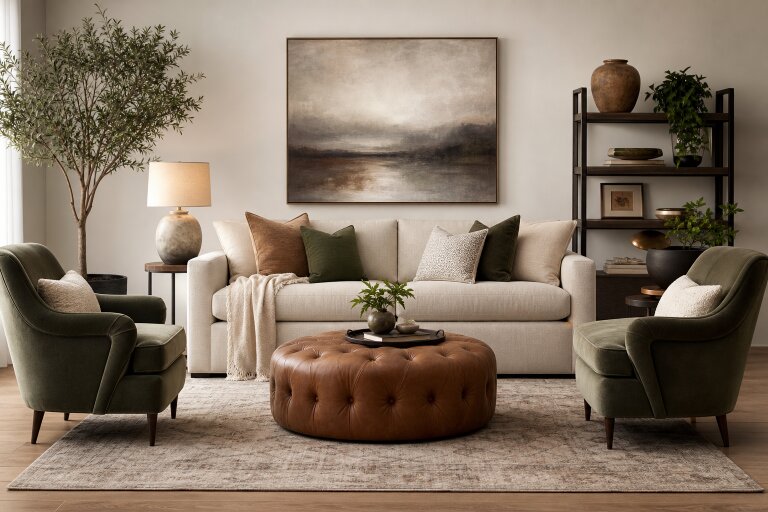
- Sofa with accent chairs: A balanced option for conversation-focused rooms, since chairs can be angled, moved, or replaced more easily.
- Modular seating: Practical for households that expect to rearrange furniture, move, or adapt the room over time.
- Chair-and-ottoman pair: Ideal for a reading corner or as a comfortable secondary seating zone.
3. Get Scale and Measurements Right
Do not measure only the width of a sofa. Check its full footprint, including seat depth, arm width, back height, and the clearance needed to walk around it. A piece may technically fit against a wall but still make the room feel crowded or difficult to navigate.
Use painter’s tape to outline the proposed furniture footprint on the floor. Then walk around it, open nearby doors and drawers, and imagine carrying laundry, groceries, or toys through the room. Measure the delivery route too, including elevators, stairwells, hallways, turns, and entry doors.
4. Match Comfort to the Household
Seat depth and cushion firmness strongly affect how a sofa feels. Deep seats often suit lounging, naps, and taller users, while shallower seats can be better for upright conversation and smaller spaces. Medium or firmer cushions often make it easier to stand up and can hold their shape well with frequent use.
Test seating in more than one position. Sit back, lean forward, place your feet on the floor, and see whether the arm height feels natural. The basics of upholstery, including padding, support systems, and covering materials, all contribute to everyday comfort.
5. Select Upholstery for Real-World Conditions
Choose fabric or leather based on the home you have, not an idealized version of it. Consider pets, children, food, drinks, direct sunlight, and how often the room is used. Texture, weave, color, and finish can all influence how easily marks, pet hair, fading, and wear show over time.
Ask for physical samples before deciding, since screens rarely show true color or texture. Request care instructions, warranty details, and information about replacement cushions. Natural leather may show variation in grain, markings, and tone, which can add character but should be expected.
6. Use Custom Details to Solve Room Problems
Customization is not only about appearance. It can help solve awkward walls, narrow spaces, and open-plan rooms that need a clearly defined seating zone. Slimmer arms can preserve usable seat width, while a higher back may provide more support. Cushion layouts, leg finishes, materials, and back styles can also make a piece feel more personal without sacrificing function.
7. Plan Around Conversation and Movement
Arrange seating so people can comfortably see and speak to one another. Keep a coffee table or side table within easy reach, but leave room to pass through without squeezing. Avoid aiming every seat directly at the television if the room is also used for hosting. In open spaces, rugs, lighting, and consoles can help define a living area without adding walls.
8. Balance Style With Long-Term Flexibility
Think beyond the current layout. Will the seating still work after a move, renovation, or change in household needs? Instead of buying a perfectly matched set, consider complementary pieces that can be rearranged. Movable chairs, ottomans, and modular components often offer more flexibility than one oversized piece.
Quick Decision Checklist
- Measure the room and delivery route.
- List the room’s main activities and users.
- Choose a seating shape that supports those routines.
- Check seat height, depth, cushion feel, and back support.
- Select upholstery for cleaning needs and expected wear.
- Keep doors, walkways, recliners, and drawers clear.
- Review samples, care instructions, and warranty details.
- Choose details that improve both comfort and visual balance.
Common Questions
Should a sofa be chosen before the rest of the room?
Usually, yes. The main sofa often establishes the scale and seating arrangement, but measurements and traffic flow should be confirmed before ordering.
Is a sectional better than a sofa?
Neither is always better. A sectional can offer generous lounging space, while a standard sofa often gives a room more layout flexibility.
What works best for pets and children?
Look beyond appearance. Ask about cleaning methods, weave durability, finishes, color variation, and the manufacturer’s care guidance.
How can a small living room feel more comfortable?
Choose slimmer arms, moderate seat depth, raised legs, lighter visual weight, and movable pieces. Most importantly, protect the walking paths.
Choose for Life Inside the Room
The best living room seating is not necessarily the largest or most fashionable option. It is the seating that fits the room, feels good to use, supports the household’s routines, and remains practical over time. Measure first, test comfort carefully, compare materials, and prioritize choices that make daily living easier.
